




Why the everyday digital routines that keep small businesses moving also create opportunities for attackers.
A cyberattack doesn’t always start with something that looks unusual.
It can simply begin with a delivery notification arriving while an employee waits for a package. A meeting invitation before the next call. A shared document from what appears to be a colleague. A new AI tool someone wants to try. Or an invoice that needs to be paid before the end of the day.
These are not unusual behaviors. They are part of the working day.
That’s precisely what makes them useful to attackers.
The more normal the interaction, the less reason there is to question it.
More and more, SMBs depend on digital services to perform routine tasks. Documents move through cloud platforms. Meetings start from links. Suppliers send invoices electronically. Employees download files, access shared code, track deliveries, and experiment with new online tools.
Cybercriminals don’t have to invent completely new behaviors to reach those employees. They can position malicious activity inside behaviors that already exist.
Our Threat Intelligence Lab in Allot helps us see that pattern.
More than 60% of blocked domains for SMBs in Q2 were linked to an identifiable digital activity or market. And 80% of those signals were concentrated in just ten categories, led by technology, shopping and marketplaces.
The significance isn’t simply which categories appear most often.
It’s that so many threats connect to something recognizable that people already do online.
An ordinary day creates multiple opportunities.
Think about the activities list below. Aren’t they the expected day-to-day actions for an average SMB?
Tracking a delivery, joining a meeting online, opening a document shared by a familiar vendor, checking out a new AI tool, or handling a supplier payment. Nothing about that day sounds risky, right?
Yet the real threats the protection service stopped included examples built around exactly these kinds of interactions: delivery tracking, meeting invitations, document access, AI tools, shared code, document signing, recruitment, and online learning.
The attacker benefits from something very simple: interaction is already expected.
A document is supposed to be opened.
A delivery link is supposed to be clicked.
A meeting invitation is supposed to lead somewhere.
The malicious interaction doesn’t have to convince the employee to do something completely out of character. It only needs to fit naturally enough into what they are already doing.
The probability of being exposed to cyber threats is higher than not being.
This matters because cyber exposure isn’t confined to a small subset of SMBs.
Across millions of protected SMBs analyzed for the report, the share encountering at least one live cyber threat increased as the observation period expanded. Within six months, over 60% of SMBs faced cyber threats.
The working day isn’t going to become less digital.
For SMBs, the answer cannot be to stop opening documents, clicking meeting links, accessing cloud applications, or making payments. Those interactions are the business.
And they increasingly happen beyond the traditional office. Employees access work email, documents, financial services, and remote-working tools from mobile devices as part of their normal day.
That changes the cybersecurity challenge.
Instead of asking employees to treat every digital interaction as potentially dangerous, protection needs to operate around the normal behaviors the business depends on.
Get the full SMB Threat Playbook to see the data and real threats behind these everyday attack opportunities.
 SMB Cybersecurity Survey 2026: Insights & Opportunities for Telcos
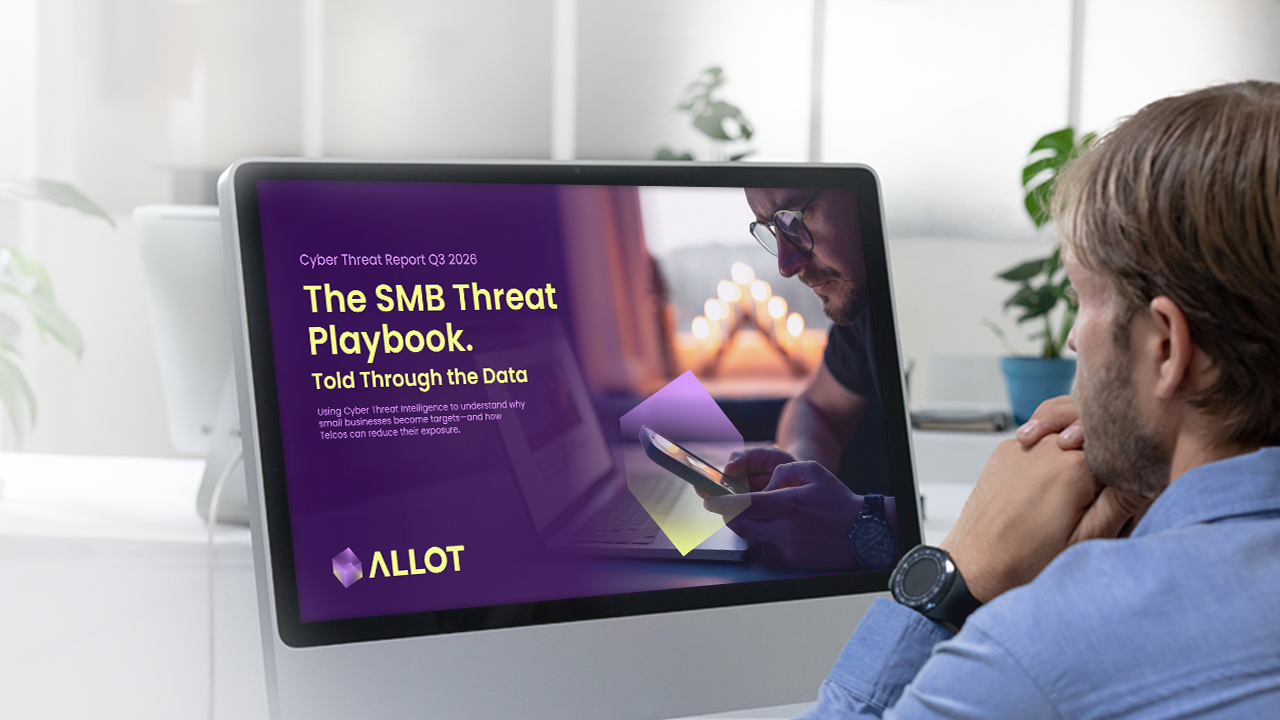 The SMB Threat Playbook | Cyber Threat Report Q3 2026
 Allot Secure Cybersecurity Solutions for SMBs
Recent Blog Posts

 August 26, 2026